
North Dakota State Flag |

North Dakota State Seal |
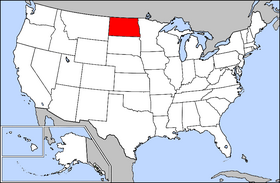
North Dakota Location |
North Dakota
North
Dakota is a state of the United
States, named after the Dakota segment of the Sioux Native American
Indians. Its U.S. postal abbreviation is ND. The entire state is covered
by area code 701.
The United States
Navy vessels USS North Dakota and Flickertail State were named in honor
of North Dakota.
| Capital |
Bismarck |
|
| Largest
City |
Fargo |
| Governor
(2005) |
John
Hoeven (R) |
Area
- Total
- Land
- Water
- % water |
183 272 km² (19th)
178 839 km²
4 432 km²
2.4% |
Population
- Total (2000)
- Density |
642 200 (47th)
3.59 /km² (47th) |
Admittance
into Union
- Date
- Order |
November 2, 1889
39th |
| Time
zone |
Central:
UTC-6/-5 (northwestern and eastern)
Mountain: UTC-7/-6 (southwestern) |
Latitude
Longitude |
45°55'N
to 49°00'N
96°33'W to 104°03'W |
Width
Length
Elevation
- Highest
- Mean
- Lowest |
340
km
545 km
White Butte, 1 069 m
580 m
Red River, 229 m |
| ISO
3166-2 |
US-ND
|
| Official languages |
English |
| State
nickname |
Peace
Garden State, Roughrider State, Flickertail State |
| |
|
|
Geography and Climate
North
Dakota is bordered on the north by the Canadian Provinces of Saskatchewan
and Manitoba, on the
west by Montana, on the
south by South Dakota, and
on the east, across the Red River of the North and the Bois de Sioux
River, by Minnesota. The
Missouri River flows through the western part of the state, forming
Lake Sakakawea behind the Garrison Dam.
Farms and ranches
stretch across the rolling plains from the Red River Valley in the east
to the rugged Badlands in the west. The geographic center of the North
American continent is located near Rugby.
North
Dakota is a prime example of a continental climate; distant from
major bodies of water to moderate the weather, conditions range from
sweltering heat and humidity to bitter cold. Competing warm airmasses
from the Gulf of Mexico and cold airmasses from the Arctic regions invaribly
produce strong winds as they move in and out of the region.
In summer, the clash of arctic
and tropic systems often leads to strong thunderstorms, sometimes including
damaging hail and tornadoes. In winter, the weather tends to be more
stable — cold and dry, with occasional flurries—though the
constant wind tends to create blowing snow at any time of the season.
Severe snowstorms tend to manifest late in the fall or early in the
spring, as was the case in 1997.
North Dakota's reputation
for severe weather has been cited by many as a motivating factor behind
outmigration and the failure of outside industry to locate in the state,
though some have found this to be a secondary factor to the overall
economic situation in the state.
History
The Dakotas made
up the last arable region in the United
States to be explored and settled. The French-Canadian trader La
Vérendrye was the first documented non-Native American explorer
of the area, leading a party to the Mandan villages about 1738.
The trading arrangement between
tribes was such that North Dakota tribes rarely dealt directly with
Europeans. However, the native tribes were in sufficient contact that
by the time of Lewis and Clark, they were at least somewhat aware of
the French, then Spanish claims to their territory.
The state was settled
sparsely until the late 1800s, when the railroads pushed through the
state, and aggressively marketed the land. On 2 November 1889, North
Dakota was admitted to the Union with South
Dakota.
The territorial and early
state governments were largely corrupt. Early in the 20th century, a
wave of populism led by the Non Partisan League brought social reforms.
The Great Depression was rough on the state and came several years early
with the 1920s farm crisis. The original state capitol burned to the
ground in the 1930s and was replaced by a concrete art deco skyscraper
that still stands today.
The 1950s brought
a wave of federal construction projects, including Garrison Dam and
the Minot
and Grand
Forks Air Force bases. The 1980s saw an oil boom in the Williston
basin, as skyrocketing petroleum prices made development profitable,
driving state population to a peak near 800,000. Since then the state
has been experiencing a period of economic and demographic decline,
and population is down to around 640,000, about as many as lived in
the state in 1920s.
Law and Government
The capital of North
Dakota is Bismarck
and its current governor is John Hoeven (Republican). Its two current
U.S. senators are Kent Conrad (Dem-NPL) and Byron Dorgan (Dem-NPL).
Its congressman is Earl Pomeroy (Dem-NPL).
North
Dakota has a bicameral legislature. The state elects two House Representatives
and one Senator from each of 47 districts apportioned by population.
The legislature meets in an 80-day regular session in odd-numbered years,
and in special session if summoned by the governor.
The major political
parties in North Dakota
are the Republican Party and the Democratic-NPL Party. However, North
Dakota does have some active third parties.
The Republican Party
holds large majorities in the state legislature and generally wins the
state's 3-member electoral college delegation; Since 1964, no Democratic
presidential candidate has won North
Dakota. In 2004, George W. Bush won with 62.9% of the vote.
On the other hand, Dem-NPL
candidates for North Dakota's federal Senate and Congressional seats
have won every election since 1986.
The structure of North Dakota's
judiciary is not terribly complex. Each of the 53 counties has a court,
from which appeals are sent directly to the North Dakota Supreme Court.
Because of the expense of having each county hire a judge, and the fairly
low workload, the state is divided into seven judicial districts which
collectively elect judges to travel to the various courthouses and hear
cases.
District Judges
are elected to six-year terms. Supreme Court Judges are elected to ten-year
terms. The Supreme Court Justice is selected every 5 years by vote of
the District and Supreme Court Judges.
Economics
The U.S. Bureau of Economic
Analysis estimates that North Dakota's total state product in 2003 was
$21 billion. Per capital personal income in 2003 was $28,922, 32nd in
the nation.
Agricultural activity is
largely dependent on rainfall. Wheat (particularly the durum variety
used for pasta), barley, soybeans, sunflowers, and flax are present
throughout the state, the wetter Red River Valley is dominated by farms,
with the chief crops being Sugar beets and maize. Cattle ranches are
more common in the dry southwest, though dairy ranches are more common
toward the east. Honey is produced in the central part of the state.
Small quantities of juneberries and grapes support a modest domestic
winery industry.
The state's small industrial
output includes electric power, food processing, machinery (including
Bobcat heavy equipment), lignite mining, and tourism.
North
Dakota has the only state-owned bank in the United
States, the Bank of North Dakota. The bank, by law, holds all funds
of all state and local government agencies in North
Dakota. Its deposits are not guaranteed by the FDIC, but by the
State of North Dakota itself.
Demographics
|
According to the U.S. Census Bureau, as of 2004,
North Dakota's population was 634,366. The state's population
had declined nearly 8,000 since 2000, a 1.2% drop.
North
Dakota is 47th of the 50 states in population, ahead of only
Vermont, Alaska,
and Wyoming.
Race and Ancestry
The racial
makeup of the state:
91.7% White
4.9% Native American
1.2% Hispanic
0.6% Asian
0.6% Black
1.2% Mixed race
The five largest ancestry groups in North
Dakota are: German (43.9%), Norwegian (30.1%), Irish (7.7%),
Native American (5%), Swedish (5%).
Most North
Dakotans are of Northern European descent, especially Scandinavian
and German. People of German ancestry are present throughout the
state, especially the southern and central counties, and Scandinavians
are also present throughout. A few counties have large Native
American populations (principally on reservations). Individuals
counties in western North
Dakota have the largest white, Russian, Ukrainian, and Hungarian
percentages of any county.
6.1% of North
Dakota's population were reported as under 5, 25% under 18, and
14.7% were 65 or older. Females made up approximately 50.1% of
the population.
Outmigration
North
Dakota has experienced a decline in population over the last
20 years, primarily among skilled college graduates for whom there
are few jobs in the state. State leaders have been at a loss to
address the issue. Student loan forgiveness programs for health
and education professionals have been initiated with some degree
of success, but a larger program to forgive the loans of all college
graduates residing in the state for a given period of time failed
to pass a referendum. Some federal politicians, including Byron
Dorgan, have proposed a new "Homestead Act" to incentivize
living in areas losing population through tax breaks and other
considerations, but these have also made little headway.
Many North
Dakota politicians believe that better economic development programs
will eventually resolve the issue, but opinions are mixed as to
what exactly that would entail.
Religion
A very large
majority of North Dakotans self-identify as Christian. It has
the lowest percentage of non-religious people of any state, and
it also has the most churches per capita of any state. The current
religious affiliations of the people of North Dakota are shown
in the table below:
Christian
– 97%
Protestant – 66%
Lutheran – 39%
Methodist – 8%
Baptist – 7%
Other Protestant – 12%
Roman Catholic – 30%
Other Christian – 1%
Other Religions – <1%
Non-Religious – 3%
|
| Historical
populations |
Census
year |
Population
|
1870 |
2,405 |
1880 |
36,909 |
1890 |
190,983 |
1900 |
319,146 |
1910 |
577,056 |
1920 |
646,872 |
1930 |
680,845 |
1940 |
641,935
|
1950 |
619,636 |
1960 |
632,446 |
1970 |
617,761
|
1980 |
652,717
|
1990 |
638,800 |
2000 |
642,200
|
|
Important Cities and Towns
By population, the ten largest
urban centres in the state are:
1. Fargo/West
Fargo
2. Bismarck/Mandan
3. Grand Forks
4. Minot
5. Dickinson
6. Jamestown
7. Williston
8. Wahpeton
9. Devils Lake
10. Valley City
The population trends in the state are noting a distinct shift from
the rural areas to the larger cities. Most of North Dakota's largest
communities grew between 1990 and 2000.
Between 1990 and
2000, the USA as a whole grew by 13.1%, yet North
Dakota grew a mere 0.5%. It is the only state (along with Washington
DC) whose population declined (by 1.3%) between April 1, 2000 and
July 1, 2003; this decline has become a major political issue.
Colleges and Universities
North Dakota's leaders frequently
boast that the educational scene in the state is excellent. However,
because the economic situation is no match for it, many skilled graduates
leave the state.
North
Dakota boasts one of the healthiest higher education scenes in the
nation. There are 11 public colleges and universities, five tribal community
colleges, and four private schools in the state. The largest and oldest
institution is the University of North Dakota in Grand
Forks.
The higher education
system consists of the following institutions:
- North Dakota
University System (Public schools)
|
Tribal
colleges
Private
schools
|
Miscellaneous
Counties: 53
State bird: Western Meadowlark, Sturnella neglecta
State fish: Northern pike, Esox lucius
State horse: Nokota Horse
State flower: Wild Prairie Rose, Rosa arkansana
State tree: American Elm, Ulmus americana
State fossil: Teredo Petrified wood
State grass: Western Wheatgrass, Pascopyrum smithii (Rydb.) A. Löve
State nicknames: Roughrider State, Flickertail State, Peace Garden State
State mottos:
(Seal of North Dakota) Liberty and Union, Now and Forever, One and Inseparable
(Coat of Arms of North Dakota) Strength from the Soil
State song: North Dakota Hymn
State dance: Square Dance
State march: Flickertail March
State beverage: Milk
A bill for statehood
for North and South Dakota (and Montana,
and Washington) was passed on February 22, 1889
during the Administration of Grover Cleveland. It was left to his successor
Benjamin Harrison to sign proclamations formally admitting North and
South Dakota to the Union on November 2, 1889. However,
the rivalry between the northern and southern territories presented
a dilemma: only one, upon the President's signature on the proclamation,
could gain the distinction of being admitted before the other. So Harrison
directed his Secretary of State James Blaine to shuffle the papers and
obscure from him which he was signing first, and the priority went unrecorded.
The Flickertail State is
one of North Dakota's nicknames. The nickname is derived from Richardson's
Ground Squirrel (Spermophilus richardsonii), a very common animal in
the region. The squirrel constantly flicks its tail in a distinctive
manner. In 1953, legislation to make the squirrel the state animal was
voted down in the state legislature.
The
above article in gray is licensed under the
It
uses material from the
|


